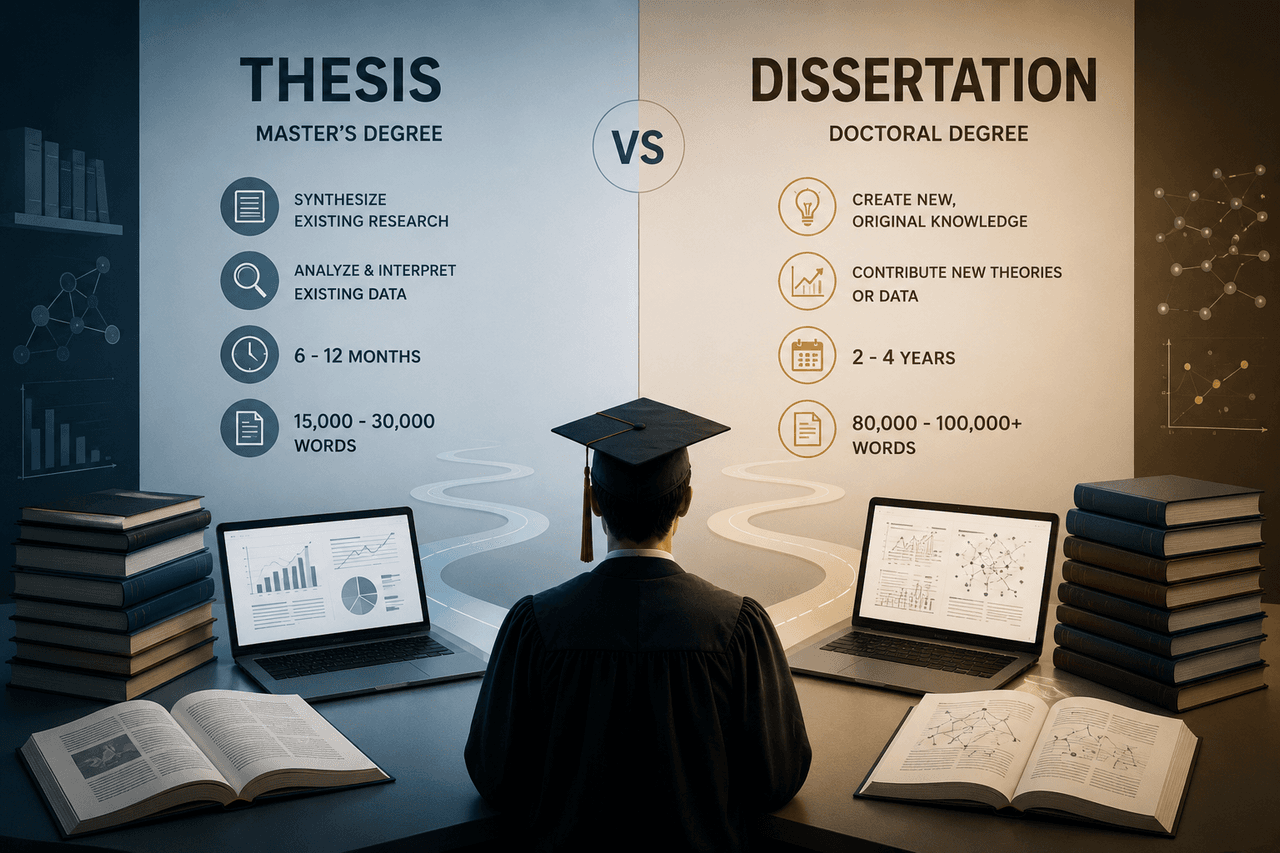
The fundamental difference between a thesis and a dissertation lies in the level of original research required and the academic degree they support. For graduate students embarking on their advanced studies, understanding whether you are expected to synthesize existing knowledge or create entirely new academic theories is critical to your success. Despite the terms often being used interchangeably in casual conversation, academic institutions maintain strict definitions that dictate graduation requirements.
Navigating the academic landscape can be confusing, especially because terminology flips depending on whether you are studying in the United States or the United Kingdom. This comprehensive guide clarifies the exact distinctions between these two major academic milestones, outlining expectations for length, original contribution, and the defense process so you can approach your graduate research with total clarity.
💡Key Takeaways
In the U.S., athesis typically completes a master’s degree; a dissertation completes a doctorate.
A thesis emphasizes synthesis and analysis of existing research; a dissertation requires original contribution to the field.
UK and many European institutions often reverse the terminology—verify your university’s definitions before you start.
Length, timeline, and defense rigor scale sharply from master’s thesis to doctoral dissertation.
Understanding the Academic Definitions
In the context of the American higher education system, the definitions of a thesis and a dissertation are tied directly to the degree being pursued. A thesis marks the culmination of a master’s program, while a dissertation serves as the final requirement for a doctoral (PhD) program. Both documents require extensive literature reviews and strict adherence to academic formatting, but their foundational goals are entirely different.
The primary distinction is the intellectual contribution. A master’s student must prove they understand their field, while a doctoral candidate must prove they can advance it.
Academic advisory data suggests that students who clearly understand this distinction during their first year finish their final documents20 percent fasterthan those who do not.
What Constitutes a Master’s Thesis
A master’s thesis is an extensive research paper that demonstrates a student’s deep understanding of their academic discipline through the compilation and analysis of existing literature. The primary goal is to prove methodological competence and critical thinking skills. You are evaluating what other scholars have already discovered rather than inventing a new paradigm.
For example, a master’s thesis in psychology might involve running a statistical meta-analysis on ten existing studies regarding cognitive behavioral therapy. You are adding value through organization and synthesis, but you are not expected to conduct a multi-year, original clinical trial.
What Constitutes a Doctoral Dissertation
A doctoral dissertation is a comprehensive document detailing entirely original research that contributes a novel concept, theory, or dataset to the academic community. The goal is to fill a specific gap in the existing literature. A dissertation proves that the candidate is capable of functioning as an independent scholarly researcher.
To write a dissertation, you must identify a problem that no one else has solved, design a unique methodology to study it, and defend your findings.
Institutional statistics show that a standard PhD dissertation takes an average ofthree to four yearsof dedicated research to complete.
Core Differences Between a Thesis and a Dissertation
The core differences between these two academic documents center on originality, scope, length, and the final academic outcome. Understanding these parameters helps graduate students scope their research correctly and avoid "scope creep," which is the leading cause of delayed graduation.
To clarify these expectations, researchers can refer to the standard American academic framework for graduate requirements.
Feature | Master's Thesis | Doctoral Dissertation |
|---|
Primary Purpose | Synthesize and analyze existing research | Create entirely new, original knowledge |
Degree Supported | Master's Degree (MA, MS, MFA) | Doctorate (PhD, EdD, DBA) |
Originality | Moderate (new perspective on existing data) | High (discovering new data or theories) |
Average Length | 15,000 – 30,000 words | 80,000 – 100,000+ words |
Timeline | 6 to 12 months of writing | 2 to 4 years of research and writing |
Regional Differences in Academic Terminology
Regional differences in academic terminology create the majority of confusion surrounding these terms, as the United Kingdom and European institutions flip the American definitions entirely. In the UK, Australia, and many European countries, a student writes a"dissertation"to complete their bachelor's or master's degree, and they write a"thesis"to earn their PhD.
If you are applying to international programs, you must verify the local terminology. For instance, a European university asking for a "thesis proposal" is expecting a multi-year doctoral research plan. Conversely, an American university asking for the same document is expecting a one-year master's level project. Always consult your specific university's style guide to ensure you are using the correct nomenclature.
Scope, Length, and Structural Expectations
The scope and length of your final document are dictated by the complexity of your methodology and the traditions of your specific academic discipline. A dissertation is inherently larger in scope because proving a novel theory requires exhaustive data collection, whereas a thesis requires only enough evidence to support a comprehensive analytical synthesis.
Regardless of the document type, both follow a similar structural spine—introduction, literature review, methodology, results, discussion, and conclusion. However, the methodology and results sections in a dissertation will be exponentially longer and more detailed than those found in a master's thesis.
Typical Word Counts and Timelines
Typical word counts vary by discipline, but a standard master's thesis generally ranges from15,000 to 30,000 words, while a doctoral dissertation spans80,000 to 120,000 words. STEM dissertations tend to be shorter and heavily data-driven, while humanities dissertations routinely push the upper word count limits due to extensive narrative analysis.
In terms of timelines, a master's student usually spends their final semester or two researching and writing their thesis. A doctoral candidate, however, will spend the majority of their four-to-six-year program focused solely on their dissertation research.
The Academic Defense Process
The academic defense process is the final hurdle for both degrees, though a dissertation defense is significantly more rigorous and interrogative. During a thesis defense, the committee usually checks to ensure the student understands the field's fundamental concepts. The tone is often collaborative and developmental.
During a dissertation defense—often called aviva vocein the UK—the candidate is treated as a peer and challenged aggressively on their methodologies and conclusions. The committee's goal is to ensure the original research is robust enough to be published in peer-reviewed academic journals.